#1 Overall Winner
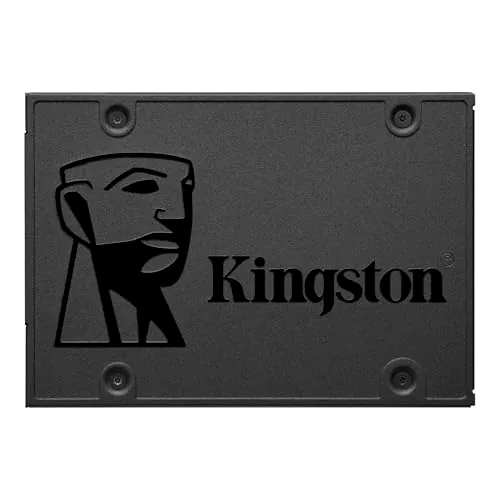
Kingston 120GB A400 SATA 3 2.5-inch Internal SSD SA400S37/120G
- Up to 500MB/s read and 450MB/s write specifications for a major upgrade over a mechanical hard drive.
Comparison
The Kingston A400 120GB and 480GB are closely related 2.5-inch SATA SSDs with the same advertised maximum read and write speeds. The 480GB model is the stronger all-round option because it offers substantially more storage and higher overall reliability and satisfaction results, while the 120GB model fits a basic boot-drive upgrade with limited storage needs.
#1 Overall Winner
Contender
Choose the 120GB A400 for a low-storage boot-drive upgrade in an older PC. Choose the 480GB A400 for a more versatile everyday drive with room for applications and files. Both make the most sense as SATA HDD replacements, not as high-write-workload or PCIe-performance drives.
Overall winner
Depends on your needs
| Feature | Kingston 120GB A400 SATA 3 2.5-inch Internal SSD SA400S37/120G | Kingston 480GB A400 SATA 3 2.5-inch Internal SSD SA400S37/480G | Winner |
|---|---|---|---|
Capacity |
120GB |
480GB |
Kingston 480GB A400 SATA 3 2.5-inch Internal SSD SA400S37/480G |
Advertised read speed |
Up to 500MB/s |
Up to 500MB/s |
Tie |
Advertised write speed |
Up to 450MB/s |
Up to 450MB/s |
Tie |
Overall assessment |
Strong |
Stronger |
Kingston 480GB A400 SATA 3 2.5-inch Internal SSD SA400S37/480G |
Everyday usability |
Excellent |
Excellent |
Kingston 120GB A400 SATA 3 2.5-inch Internal SSD SA400S37/120G |
Reliability confidence |
Some early-failure reports |
Stronger review confidence |
Kingston 480GB A400 SATA 3 2.5-inch Internal SSD SA400S37/480G |
Heavy mixed workloads |
Not specifically detailed |
Not ideal |
Depends |
Compatibility |
Desktop and laptop |
Laptop and mobile computing devices |
Kingston 120GB A400 SATA 3 2.5-inch Internal SSD SA400S37/120G |
Portability |
Very compact |
Compact |
Kingston 120GB A400 SATA 3 2.5-inch Internal SSD SA400S37/120G |
Customer feedback |
4.7/5 from 28,572 reviews |
4.8/5 from 204,504 reviews |
Kingston 480GB A400 SATA 3 2.5-inch Internal SSD SA400S37/480G |
Value |
Strong for minimal storage needs |
Strong for broader storage needs |
Kingston 480GB A400 SATA 3 2.5-inch Internal SSD SA400S37/480G |
Best fit |
OS and essentials |
OS, apps, and files |
Depends |
For ordinary SATA use, the two drives are closely matched: both advertise up to 500MB/s reads and 450MB/s writes, and both are intended to improve booting, loading, and file transfers relative to a mechanical hard drive. The 480GB model earns a slightly higher performance score and has more room to avoid the immediate storage constraints of the 120GB drive. The 120GB model holds a slightly higher speed score, but neither listing supports treating it as a fundamentally faster drive.
Neither is positioned for sustained, demanding mixed workloads. Review evidence for the A400 family notes that heavy small-file writes can be weaker than on higher-end SSDs.
On paper, speed is a tie: both drives list up to 500MB/s read and 450MB/s write. The 120GB A400 has a slightly higher speed score, while the 480GB A400 has a slightly higher overall performance score. Both should feel much faster than a mechanical HDD for booting and loading, but neither should be selected for a PCIe-class speed upgrade.
The 480GB A400 has the stronger reliability score. Its review data includes many reports of dependable operation, including longer-term use, although immediate recognition is not universal. The 120GB A400 also has many satisfied users and reports of drives still working well, but its aggregated review data includes reports of failure within six months.
For either model, important files should be backed up independently; SSD selection does not remove the need for a backup plan.
Both drives are strong everyday upgrades. Reviews for each repeatedly mention simple installation, quick operating-system setup, and a clear improvement in responsiveness after an HDD replacement. The 120GB version has a small advantage in the supplied usability score, while the 480GB version remains highly rated and is easier to live with for users who need more local storage.
Installation can still require initializing or formatting a secondary drive, migrating an existing system, or performing a clean operating-system install. The 120GB review data also notes that screws and cables may not be included.
Both drives use the familiar 2.5-inch internal SATA SSD format, making them practical replacements for compatible laptop and desktop hard-drive bays. The 480GB listing specifically describes a 7mm profile intended for slimmer notebooks and constrained spaces. The 120GB model has the higher design and portability scores, but the central design decision is capacity rather than physical format.
Both models use solid-state flash storage with no moving parts, which supports quiet operation and resistance to shock and vibration compared with a mechanical drive. The 480GB A400 has the higher build-quality score and a higher durability score. Reviews for both include positive long-term experiences, although the 120GB feedback also contains some early-failure reports.
Both A400 drives benefit from having no moving parts and are described as shock- and vibration-resistant. The 480GB version holds the higher durability score and has more positive long-term review evidence in the supplied data. The 120GB version can still be a practical HDD replacement, but its early-failure reports make the 480GB the more reassuring choice on the available evidence.
Both are lightweight internal 2.5-inch drives, so portability is mainly about their suitability for laptops rather than carrying them externally. The 120GB version has the higher portability score. The 480GB version remains compact and its stated 7mm profile is useful for compatible slim laptops, but it does not have a meaningful travel-use advantage over the smaller-capacity model.
Feature sets are largely the same. Both are Kingston A400 2.5-inch internal SATA SSDs using flash memory without moving parts, with SATA Rev. 3.0 support and stated backwards compatibility with SATA Rev. 2.0. Both are described as cooler, quieter, and more shock- and vibration-resistant than mechanical hard drives.
The practical feature advantage belongs to the 480GB model because storage capacity is itself the key functional difference. Its listing also specifically highlights a 7mm form factor for compatible slim notebooks.
Setup is a strength for both drives. Users describe quick installation, successful Windows installs, and simple migration from older hard drives. The 120GB A400 has a marginally higher setup score, but the difference is small and both are practical for an owner comfortable opening a compatible computer.
First-time installers should plan for the correct SATA cable or adapter, mounting hardware if needed, and either cloning software or operating-system installation media.
Both drives require a compatible SATA connection and a suitable 2.5-inch installation location. The 120GB model has the higher compatibility score and is explicitly listed for desktops and laptops. The 480GB model is intended for laptops and mobile computing devices, and its 7mm profile can help with compatible thin notebooks. Since some 480GB buyers reported detection issues, verify the host interface and installation requirements first.
Both products connect through SATA and are stated to support SATA Rev. 3.0 with backwards compatibility to SATA Rev. 2.0. The 120GB model has the higher connectivity and compatibility scores and explicitly lists desktop and laptop compatibility. The 480GB model is also designed for compatible laptops and mobile computing devices, but its review summary includes a small number of reports where computers did not recognize the drive.
Before buying either, confirm that the host device has an available 2.5-inch SATA bay or appropriate adapter and cable arrangement.
Both SSDs are described as cooler and quieter than mechanical hard drives, with no moving parts. The 120GB A400 has a slightly higher power-efficiency score, though no direct power-consumption figures are supplied for a detailed comparison. For users moving from an HDD, either should offer the general efficiency benefits associated with solid-state storage.
Both drives score strongly for value because they offer a clear responsiveness upgrade for compatible HDD-based systems. The 120GB version is best value when a small boot drive is genuinely sufficient. The 480GB version has the slightly higher value score and offers materially more practical capacity, stronger reliability results, and higher customer satisfaction, making it the better-rounded value choice for most users.
The decision should not be based on purchase price alone: consider storage needs, workload type, compatibility, and the need to keep free space available.
This is effectively a tie because both products are Kingston A400 drives. Kingston has strong brand-trust scores in both supplied assessments, with the 480GB version marginally ahead. Review feedback for both models is generally favorable, but product-specific reports still matter: the 120GB has some early-failure complaints and the 480GB has some detection complaints.
Both listings have excellent customer feedback. The 120GB A400 holds a 4.7/5 rating from 28,572 reviews, with frequent praise for fast booting, easy installation, and upgrading old systems. The 480GB A400 holds a 4.8/5 rating from 204,504 reviews, alongside the higher customer-satisfaction score. Its feedback similarly emphasizes speed, installation ease, and strong HDD-replacement value.
The 480GB model leads on breadth and rating, while both have isolated negative reports that should be considered.
The supplied data does not provide specific warranty duration, return terms, or manufacturer support details for either model. Warranty-support scores are modest for both and are slightly higher for the 120GB version. Buyers should verify the applicable seller, return policy, and Kingston warranty terms before ordering, particularly when the drive will hold important data.
The Kingston 480GB A400 is the best overall option in this comparison. It matches the 120GB model's advertised up to 500MB/s read and 450MB/s write specifications, while adding four times the storage and earning stronger supplied results for overall quality, reliability, durability, value, and customer satisfaction. It is the more practical drive for most compatible desktops and laptops being upgraded from a hard drive.
The Kingston 120GB A400 remains a valid choice for a narrowly defined boot-drive job. It has strong setup, usability, and speed results, and review feedback supports its ability to make older systems feel more responsive. Its limited capacity and some early-failure feedback mean it is best reserved for light-use systems with modest local-storage needs. Neither model is the right fit when sustained heavy mixed-write performance is the priority.
Overall winner
Depends on your needs
The 480GB A400 is the better overall choice in the supplied scoring because it combines the same advertised SATA performance with four times the capacity, stronger reliability and durability results, and slightly higher customer satisfaction. The 120GB A400 remains sensible when the computer only needs an operating system and a few core applications.
No meaningful advertised speed difference is provided. Both listings state up to 500MB/s read and 450MB/s write performance. The 120GB version has a slightly higher speed score, but the 480GB version has a slightly higher performance score. In either case, the principal improvement is when replacing a mechanical hard drive.
It can be enough for a focused operating-system installation, essential programs, and a cloud-oriented or light-use computer. Reviews describe the 120GB drive as effective for booting older PCs. However, its small capacity leaves less room for games, photos, videos, applications, and future updates, so storage planning is important.
For most older-laptop upgrades, the 480GB A400 is the more flexible option because it retains the same advertised SATA speed while providing substantially more room for the operating system, applications, and personal files. Its 2.5-inch, 7mm design is intended for compatible slimmer notebooks, but buyers should still confirm their laptop has a compatible SATA bay.
The supplied review evidence positions the A400 as an entry-level SATA SSD. One detailed review notes that heavy mixed and small-file write activity can reduce performance compared with higher-end SSDs. These drives are better aligned with boot drives, everyday computing, general file storage, and upgrades from hard drives than demanding scratch-disk or write-intensive workloads.
Both are designed as internal 2.5-inch SATA drives and both receive strong setup feedback. The 120GB model has the marginally higher setup and usability scores, while the 480GB listing also receives repeated praise for easy installation. Actual difficulty depends on access to the device bay, available SATA cables or adapters, and whether the system needs cloning or a clean installation.
The 480GB A400 has the stronger reliability and durability scores, and many reviews describe long-term satisfactory use. The 120GB version also has many positive reports, but its aggregated feedback includes some reports of failure in under six months. Neither score set replaces maintaining backups of important data.
No. Both are 2.5-inch SATA internal SSDs, so the computer needs a compatible SATA connection and physical mounting space. The listings state compatibility with desktops and laptops, plus backwards compatibility with SATA Rev. 2.0. Some 480GB buyers reported recognition issues, so checking the system interface, cables, BIOS settings, and drive initialization requirements is prudent.
Check our rankings and expert guides to find the best electronics products for your goals.